What is Static Equipment?
Static equipment refers to mechanical equipment that does not have moving parts and is used to store, process, or transport fluids under controlled conditions. These are designed to handle high pressure, high temperature, and corrosive environments without failure.
Unlike dynamic systems, static equipment remains fixed in position. However, don’t misunderstand this as “simple.” In reality, designing static equipment is extremely complex because it must withstand extreme operational stresses for long durations without breakdown.
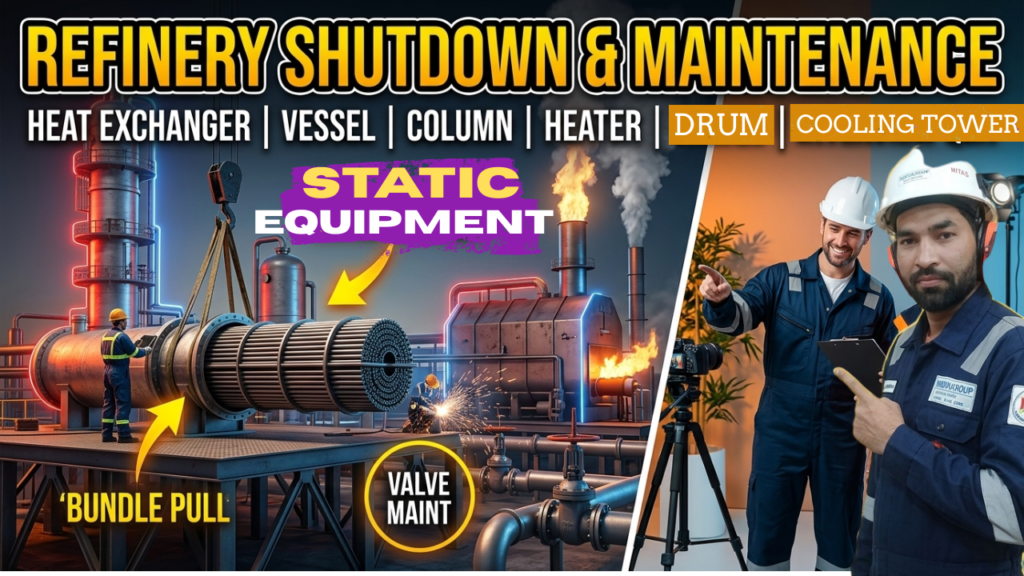
Types of Static Equipment and Functions
Heat Exchangers
A heat exchanger is one of the most commonly used static equipment in every refinery unit like CDU, VDU, FCCU, and utilities. Its main function is to transfer heat between two fluids without mixing them.
In simple words, imagine two fluids passing side by side, separated by a metal wall. One fluid is hot, and the other is cold. Heat flows from the hot fluid to the cold one. This process saves energy and improves efficiency.
Heat exchangers are used for:
- Heating crude oil before distillation
- Cooling products after processing
- Condensing steam
Without heat exchangers, energy consumption in refineries would increase drastically.
Distillation Columns (Towers)
Distillation columns are tall, cylindrical vessels used to separate liquid mixtures based on boiling points. This is where crude oil gets separated into petrol, diesel, kerosene, and other products.
Inside the column, trays or packing materials help in separating different fractions. The lighter components move upward, while heavier ones settle at the bottom.
This equipment is essential because it transforms crude oil into usable fuels. Without it, refining would not exist.
Pressure Vessels
Pressure vessels are designed to store gases or liquids at high pressure. These include drums, tanks, and separators.
They are built using strong materials like carbon steel or alloy steel to withstand extreme conditions. In real sites, you will find pressure vessels everywhere—from storage to reaction processes.
Their functions include:
- Storing hydrocarbons
- Facilitating chemical reactions
- Separating phases
Reactors
Reactors are considered the heart of the oil and gas industry. These are specialized vessels where chemical reactions take place under controlled conditions.
Processes like hydrocracking and catalytic cracking happen inside reactors, converting heavy crude into lighter, valuable products.
Without reactors, crude oil would remain useless. They are responsible for creating value in the refining process.
Drums
Drums are cylindrical vessels used for:
- Liquid accumulation
- Phase separation
- Condensation
They play a supporting role but are critical for smooth plant operation.
Furnaces
Furnaces are used to generate heat for processes like crude heating and thermal cracking.
They are essential for raising the temperature of fluids before entering distillation columns or reactors.
Separators
Separators are used to separate oil, gas, and water from the well stream. They are widely used in upstream operations.
They ensure product quality and protect downstream equipment.
Cooling Towers
Cooling towers work like heat exchangers but use evaporation to cool water.
Hot water is sprayed, air passes through it, and heat is removed. The cooled water is reused in the plant.
This helps in:
- Saving water
- Preventing overheating
- Improving efficiency
Filters and Strainers
These are used to remove impurities and particles from fluids.
They protect equipment like pumps and valves from damage and improve product quality.
Flare Systems
Flare systems are safety equipment used to burn unwanted gases safely. During emergencies or maintenance, excess gas is released and burned in flare stacks.
This prevents explosions and reduces environmental hazards. You must have seen flames coming out of tall stacks in refineries—that’s the flare system working.
Additional static equipment
Reformer – used in refining processes.
Silo – used for storing bulk materials.
Silencer – reduces noise in systems.
Pig Launcher & Receiver – Pipeline cleaning and inspection.
FAQs
1. What is static equipment in simple terms?
Static equipment is equipment without moving parts used for storage, processing, and handling fluids.
2. What are examples of static equipment?
Heat exchangers, pressure vessels, storage tanks, reactors, and distillation columns.
3. Why is static equipment important?
It ensures safe storage, efficient processing, and smooth plant operation.
4. What is the difference between static and rotating equipment?
Static equipment does not move, while rotating equipment has moving parts like pumps and compressors.
5. Which static equipment is most important in refineries?
All are important, but heat exchangers, reactors, and distillation columns are considered critical.